
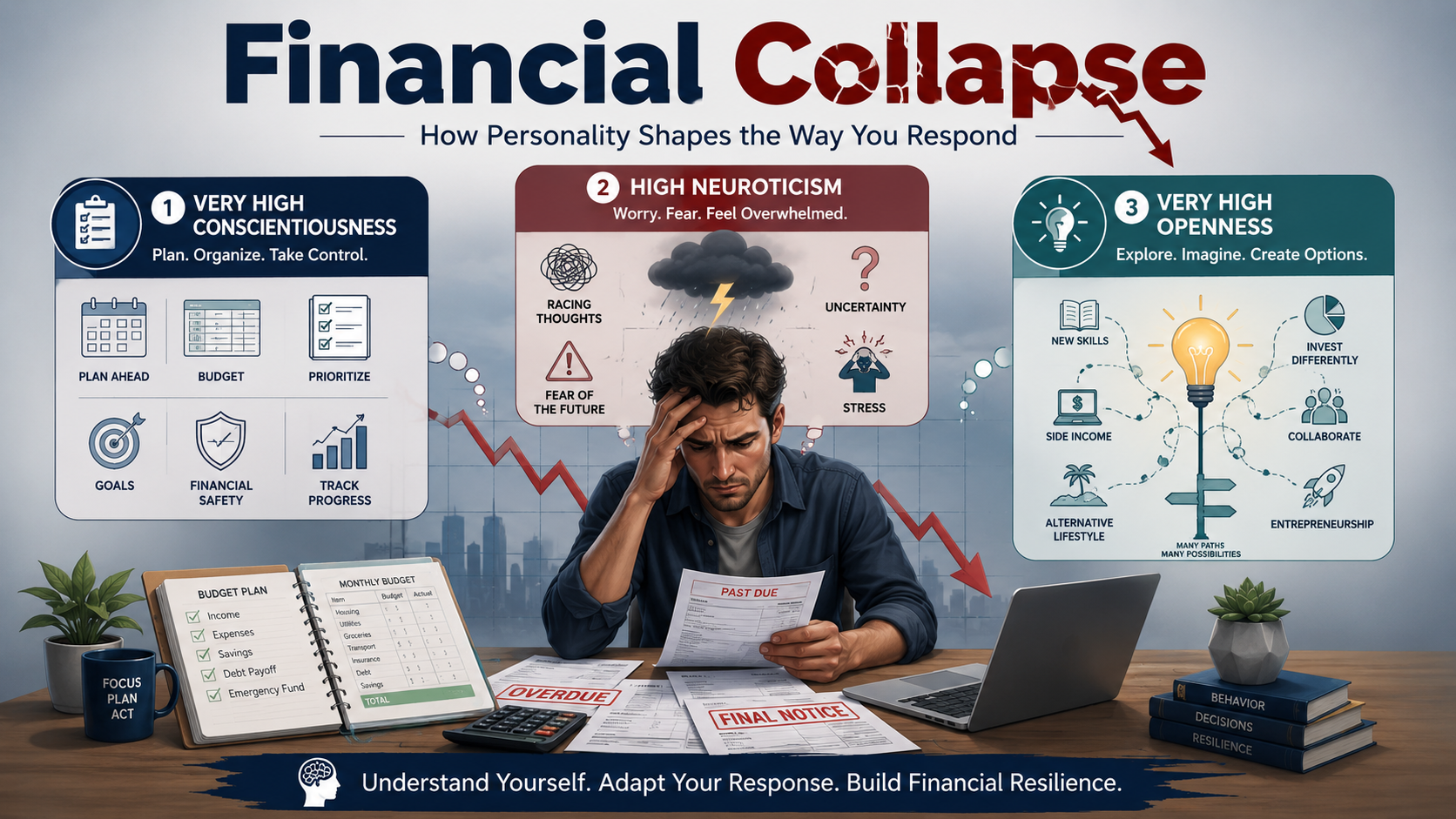
Financial collapse is not only about losing money. It can affect confidence, sleep, relationships, decision-making and the sense of control over life.
Two people may face the same financial problem but react in very different ways. One may start making lists and checking every expense. Another may feel overwhelmed and fear the worst. Someone else may think of many new solutions but struggle to choose one.
These reactions can be influenced by personality. In the Big Five personality framework, traits such as Conscientiousness, Neuroticism and Openness may shape how a person thinks, feels and behaves during serious financial stress.
When Money Problems Feel Bigger Than Numbers
A financial crisis can include job loss, business failure, heavy debt, unexpected medical expenses, falling income or the loss of savings. The practical problem is clear: there is not enough money to meet current needs. But the emotional impact is often more complex.
Financial collapse may create:
- Fear about the future
- Shame or self-blame
- Pressure to act quickly
- Conflict with family members
- Difficulty sleeping
- Repeated checking of bank balances
- Confusion about what to do next
- Loss of confidence
Personality does not decide whether a person will succeed or fail. However, it may influence which thoughts appear first and which coping habits become stronger under pressure.
Very High Conscientiousness: “I Must Fix Everything Now”
A person with very high Conscientiousness usually values planning, structure, responsibility and control. During Financial Collapse, these strengths may become more intense.
The person may start:
- Creating detailed budgets
- Checking every expense repeatedly
- Reviewing bills several times
- Making urgent repayment plans
- Cutting all non-essential spending
- Preparing multiple backup plans
- Blaming themselves for past mistakes
This response can be useful in the early stage of a financial crisis. Careful planning can help a person understand the problem and reduce unnecessary spending. However, too much checking can become exhausting.
The person may spend hours reviewing the same numbers without making a clear decision. They may feel that every small purchase is a failure. They may also set extremely strict goals that are difficult to follow.
The inner thought may be:
“If I plan perfectly, I can prevent everything from getting worse.”
But financial recovery does not always follow a perfect plan. Income can change. Unexpected costs may appear. Some decisions may need adjustment. A better approach is to create one clear budget, review it at fixed times and focus on the most important actions first.
For example:
- Protect food, housing, health and essential travel.
- List all debts and payment dates.
- Contact lenders or service providers early.
- Reduce avoidable expenses.
- Review the plan once a week, not every hour.
Structure is helpful. Constant self-pressure is not.
High Neuroticism: “Something Terrible Is About to Happen”
A person with high Neuroticism may experience emotions more strongly, especially fear, worry and uncertainty. During Financial Collapse, money problems may feel like an immediate threat to safety.
The person may worry about:
- Losing their home
- Being unable to support family
- Damaging their reputation
- Never recovering financially
- Becoming dependent on others
- Making one wrong decision
- Facing another unexpected expense
Even before the worst outcome happens, the body may react as though danger is already present. This can lead to poor sleep, panic, irritability, headaches, emotional withdrawal or difficulty concentrating. The person may avoid opening bills because they fear what they will see. In other cases, they may check accounts many times a day.
The inner thought may be:
“I am not safe, and everything may collapse.”
At this stage, emotional calming is not a waste of time. It is part of financial decision-making. A worried mind often treats every problem as equally urgent. But some problems require action today, while others can wait.
A simple method can help:
Create three categories:
Act today: rent, food, urgent bills, medical needs
Act this week: debt discussions, income search, budget changes
Review later: long-term savings, investment plans, lifestyle changes
This reduces mental overload. Talking to a trusted person can also help. Financial fear often becomes stronger when it remains private.
Very High Openness: “There Must Be Another Way”
A person with very high Openness often thinks creatively and sees many possibilities. During Financial Collapse, this can be a major strength.
The person may consider:
- Starting a side business
- Learning a new skill
- Changing career direction
- Selling unused assets
- Working online
- Moving to a lower-cost location
- Creating a new service
- Finding several new income sources
Creative thinking can help the person see opportunities that others may miss. However, very high Openness may also create too many possibilities. The person may imagine ten recovery plans but complete none. They may move from one idea to another because each new option feels more promising.
They may also imagine many possible risks:
- “What if the new business fails?”
- “What if I choose the wrong career?”
- “What if I invest time and earn nothing?”
- “What if another crisis comes?”
The inner thought may be:
“There are many possible solutions, but there are also many possible dangers.”
The solution is not to stop thinking creatively. It is to test ideas in a small and practical way. For example, instead of immediately starting a large business, the person can test the idea with five customers. Instead of leaving a job suddenly, they can build a side income first. Creativity works best when it is connected to a simple action plan.
When These Three Traits Work Together
A person with very high Conscientiousness, high Neuroticism and very high Openness may experience financial collapse in a complex way.
· Conscientiousness may push them to plan intensely.
· Neuroticism may make the situation feel urgent and frightening.
· Openness may produce many possible solutions and many possible risks.
This combination can create a cycle:
Fear leads to planning. Planning leads to more possibilities. More possibilities lead to more fear.
The person may look active from the outside, but internally they may feel confused and exhausted. The goal is to slow this cycle.
A useful response can be:
- Calm the emotional reaction
- Write down the actual financial facts
- Choose one short-term plan
- Select one recovery idea to test
- Review progress at a fixed time
- Avoid making major decisions during panic
Financial Collapse Does Not Define the Person
Financial difficulty can feel deeply personal, but it is not proof that someone is careless, weak or incapable. A person can face financial collapse because of job loss, illness, market changes, family responsibilities, business conditions or unexpected events.
Personality may shape the response, but it also provides strengths.
· Very high Conscientiousness can support discipline.
· High Neuroticism can increase awareness of danger.
· Very high Openness can generate new solutions.
The challenge is to use these traits without allowing them to become extreme. Financial recovery often begins with three things:
Clear facts, controlled action and emotional support.
A person does not need to solve everything in one day. They need to identify the next useful step and take it.