Understand how your personality works
Assessment that connects 30 personality facets to behaviour, career and stress.

Assessment that connects 30 personality facets to behaviour, career and stress.
Based on the Big Five personality framework, Truemelytics measures five dimensions through 30 underlying facets. The assessment is designed to reflect real behavioural patterns rather than surface-level labels.
Select a dimension to explore its six underlying facets.
We look deeper into trait intensity and trait interaction to understand likely behaviour. This helps explain why the same score can still lead to different actions.
Feeling lost when outcomes are unclear, leading to fear of losing direction or control.
When an important outcome is unclear, Average Neuroticism may draw your attention to what could go wrong. Because there is no firm answer yet, ordinary planning cannot settle the concern. You may spend more time thinking about the result than working on what you can do now. This can reduce your focus even while you appear active. You keep thinking about what could go wrong.
Very High Conscientiousness usually helps you set goals and follow a plan. Paired with Average Neuroticism, it may lead you to prepare more options than you can use. Because you cannot know every outcome, each new plan may create another decision. You may keep revising your steps instead of choosing one. This delays action without reducing the uncertainty.
Very High Openness helps you see possibilities that others might miss. Under this trigger, Average Neuroticism may give extra attention to the most troubling possibilities. You can then spend time comparing futures that have little evidence behind them. The result is more thought but less clarity. A possibility becomes useful only when it points to a decision you can make.
Very High Agreeableness helps you consider how a decision affects other people. Paired with Average Neuroticism, it may make you ask several people for their views before trusting your own judgment. Their answers may differ because they do not know the future either. You may feel responsible for choosing an option that satisfies everyone. This can make an already uncertain decision harder.
Very High Extraversion helps you discuss concerns and gather information quickly. With Average Neuroticism, however, repeated conversations may keep the uncertainty active. You might leave one discussion with a plan and enter another that raises new doubts. Your outward energy can remain high while your decision stays unfinished. A focused question is more useful than another general discussion.
Conscientiousness can help you separate what needs a decision now from what depends on later information. Set one near-term goal, choose the next action, and decide when you will review the plan. You can prepare well without planning for every possible result. Uncertainty can remain while useful work moves forward.
Openness can help you examine possibilities without treating each one as likely. Write down the evidence for a concern and one reasonable alternative. Then return to the choice in front of you. Several futures are possible, but they do not all need your attention today.
Agreeableness can help you seek advice with a clear purpose. Ask someone about a specific point they know well, then make the choice that fits your situation. Caring about others does not require their agreement on every step.
Extraversion can help you talk through one decision with a trusted person. State what you know and what remains unknown. A useful conversation can end with a next step, even without a final answer.
Fear of being left behind or emotionally unheld by people you depend on.
Low Neuroticism helps you stay outwardly calm, so you may carry on with your day. Still, the silence can raise a quiet question about whether the connection is secure. You check messages repeatedly for reassurance, even while telling yourself to wait.
Right after that, Low Agreeableness may make you reluctant to ask gently for reassurance. Paired with your steady Neuroticism, this can look like confidence from the outside. Inside, you may hold back a simple question because you dislike feeling dependent. The distance then lasts longer than it needs to.
As the silence continues, Very High Extraversion makes you want to talk and reconnect. Low Neuroticism helps you keep your tone even, yet a conversation may become a way to test whether the person is still close. You quietly feel unsure how to ask for comfort without making the exchange feel heavy.
Later, Very High Openness gives you several possible reasons for the change in contact. Alongside Low Neuroticism, you can consider those reasons without immediately panicking. But too many explanations can delay a direct conversation. You may overthink small changes in tone and keep searching for an answer that the available facts cannot give.
By the end of the day, High Conscientiousness may help you keep your plans and responsibilities moving. With Low Neuroticism, you can appear settled even if the relationship still feels uncertain. The risk is that you leave the concern unnamed for too long. Your composure helps you function, but it does not resolve the question between you.
Neuroticism and Agreeableness can work together when you state your need plainly and with care. You might say that the gap in contact worried you and ask when you can talk. Your calm tone can make that conversation easier, while a little warmth leaves room for the other person’s view. A need for clarity is a reasonable response to uncertainty.
Neuroticism and Extraversion can turn the urge to seek contact into an honest exchange. Reach out once, explain what you noticed, and listen to the reply. A real conversation gives you more to work with than repeated checking. Your wish to connect deserves a clear voice.
Neuroticism and Openness can help you keep several explanations in mind without treating any one of them as fact. Notice what you know, then ask about what remains unclear. A late reply alone does not tell the whole story.
Neuroticism and Conscientiousness can help you maintain your routine while you wait for a conversation. Set a time to follow up, then return to your tasks. You can seek clarity without putting the rest of your day on hold.
Deep hurt from broken trust in a close relationship, triggering emotional rupture and confusion.
When you learn that someone you love has broken your trust; High Neuroticism can make the hurt feel immediate and hard to set aside. You start questioning what was real and what was fake. Even ordinary memories may feel different now, because you are trying to understand how the betrayal happened.
Low Agreeableness may move you toward a direct challenge or a firm distance from the person. Paired with High Neuroticism, this can make anger and pain arrive together. You may want an explanation but feel unwilling to accept an easy one. The conversation can become tense before you have decided what you need from it.
As more questions arise, Very High Openness can help you notice details and consider several explanations. With High Neuroticism, those possibilities may also keep the hurt active. You quietly feel unsure which account to believe. Searching for meaning can help you learn what happened, but it may become tiring when the facts are still incomplete.
When you speak about it, Average Extraversion gives you room to choose between talking and stepping away. High Neuroticism can make either choice feel urgent. You confront, then doubt your own judgment. You may return to the conversation for another answer, even if you first need time to decide which questions matter most.
Later, Average Conscientiousness may help you handle immediate tasks without forcing a quick plan for the relationship. High Neuroticism can still draw your attention back to what happened. You may feel pressed to decide whether to stay, leave, or forgive. The hurt needs attention, but a lasting decision can wait until you have clearer facts.
Neuroticism and Agreeableness can help you express the hurt without losing your boundaries. State what happened, what you need to know, and which actions you cannot accept. You can listen to an explanation without agreeing to it. Your feelings deserve attention, and your decision deserves time.
Neuroticism and Openness can turn questions into a careful search for facts. Write down what you know and what you still need to ask. This can keep possible explanations from taking the place of evidence. Uncertainty is difficult, but it does not require an immediate conclusion.
Neuroticism and Extraversion can help you choose a supportive conversation. Talk with someone you trust, or tell the person involved when you are ready to discuss it. You may pause a discussion that becomes overwhelming. Support can make room for clearer thought.
Neuroticism and Conscientiousness can support one manageable step at a time. Set a boundary for now and decide when to review it. You can make a careful choice without solving the whole relationship today.
After investing deeply, failure feels devastating and questions self-worth or competence.
Low Conscientiousness may help you change course when a plan fails. On the other side, after giving so much effort, it may be hard to see which part of your approach needs fixing. However, the outcome does not erase what you learned or the work you completed. You need a clear review of the attempt before choosing another direction.
Average Neuroticism lets you feel disappointed without always staying caught in it. When paired with Low Conscientiousness, it can make a weak plan feel like a personal weakness. However, a result cannot tell you whether the problem was your ability, your method, or something outside your control. Those questions need separate answers.
While High Extraversion can help you discuss the setback and gather useful feedback; on the other side, you may feel exposed after others have seen how hard you tried. You compare yourself to others and feel smaller. However, their results do not explain what went wrong in your own attempt.
Very High Openness helps you find fresh approaches. But Low Conscientiousness may let you switch directions before testing what the first attempt taught you. However, a new idea will help more when you identify one change to make and follow it through.
You accept support but still keeping your own view of the setback this is due to Average Agreeableness. On the other side, you may agree too quickly with someone else’s explanation when you feel unsure of your plan. However, you can listen to feedback and still check whether it fits the facts.
Conscientiousness and Neuroticism can work together when you use concern to review the attempt without judging your whole ability. List what you controlled, what you could not control, and one change worth testing. Give yourself time to feel disappointed before making a new commitment. One failed outcome is information about an attempt, not a verdict on you.
Conscientiousness and Extraversion can help you ask for specific feedback and turn it into action. Share the part that did not work, then ask one or two useful questions. A conversation can clarify the next step without requiring you to defend every effort you made.
Conscientiousness and Openness can help you choose one promising idea and test it in small steps. Keep the lesson from the first attempt in view. You can change your approach without starting from nothing.
Conscientiousness and Agreeableness can help you accept support while setting realistic limits. Ask for help with a defined task and decide what you can manage. You do not have to recover alone.
Heavy workload under tight time pressures leads to overwhelm, panic and rushed decisions.
When several important tasks become due at once. Very High Conscientiousness makes you want to deliver each one to a high standard. You may spend too long checking one task while the others wait. The remaining time then becomes harder to divide well. Pressure rises because the amount of work exceeds the time available.
Low Neuroticism can help you think clearly, but paired with Very High Conscientiousness, it may also let you keep accepting tasks past your limit. You promise too much and regret it later. Others may assume you have enough time because you still sound composed. Pressure rises because the workload stays hidden until a deadline is close.
At this point you look for a better way to finish. High Openness can help you find useful options, while Very High Conscientiousness wants the result to be thorough. You may keep revising the approach when a workable one is already available. Choosing a method takes time that the task itself needs. Pressure rises because improvement continues after a decision is needed.
When other people ask for updates while you are trying to focus; Very High Extraversion helps you respond quickly and coordinate, but it can also fill your time with new discussions. You may shift between conversations and unfinished work. Each change of focus makes it harder to complete the next step. Pressure rises because your attention is divided across too many demands.
Low Agreeableness may help you state limits directly, yet Very High Conscientiousness can make you reluctant to hand over work that feels incomplete. You may hold on to tasks that someone else could help finish. A clear request for help could reduce the load. Pressure rises because keeping every responsibility yourself leaves too little time.
Conscientiousness and Neuroticism can help you assess the workload while staying calm. List the tasks, estimate the time each requires, and identify what must be done first. Tell others early if the full set cannot fit the deadline. A realistic plan protects the quality of the work you can complete. A limit is useful information, not a failure.
Conscientiousness and Openness can help you choose a workable method and test it quickly. Set a point when planning ends and execution begins. Save optional improvements for later if time permits. A finished priority serves you better than several unfinished possibilities.
Conscientiousness and Extraversion can support a brief, direct update to the people involved. Ask which outcome matters most and who can take a defined task. Clear coordination can reduce repeated interruptions.
Conscientiousness and Agreeableness can help you set firm limits without blame. State what you can deliver and what needs more time or support. You can remain responsible without carrying every task alone.
Repeated negative feedback damages confidence and creates emotional withdrawal or over-defensiveness.
When critical comments are made, Very High Neuroticism can make it hard to judge this comment on its own. Earlier remarks return to mind, and the new one feels heavier as a result. You may begin to expect criticism before you have heard the full message. Pressure rises because each comment adds to the concern you already carry.
You try to keep the relationship comfortable while receiving feedback. High Agreeableness may lead you to accept blame before you know which part is fair. You seek approval to feel safe again. Paired with Very High Neuroticism, that need can make a small correction feel like a threat to the whole relationship. Pressure rises because you are managing both the task and the other person’s opinion of you.
Average Extraversion gives you some room to ask questions, but Very High Neuroticism may make a public reply feel difficult. You may hold back even when you need an example of what to change. The unclear feedback then follows you into the next task. Pressure rises because silence leaves the problem undefined.
Average Conscientiousness can help you make a useful correction, while Very High Neuroticism may push you to check far beyond what was requested. You may spend extra time on small details. That effort can delay other work without addressing the main issue. Pressure rises because the standard you are trying to meet remains unclear.
You search for a reason behind the repeated comments. High Openness can help you consider different views, but Very High Neuroticism may give the most painful explanation too much weight. You may assume every remark points to a larger judgment about you. A specific work issue can then seem personal. Pressure rises because interpretation takes the place of clear evidence.
Neuroticism and Agreeableness can help you listen with care while protecting your own view. Ask which specific action needs to change, and take time before agreeing with a broad judgment. You can acknowledge useful feedback without accepting blame for everything. A correction to your work is a limited request, not a measure of your worth.
Neuroticism and Extraversion can help you turn a difficult exchange into a clearer conversation. Ask for one example and describe what you understand the next step to be. A short question can reduce uncertainty.
Neuroticism and Conscientiousness can help you make one defined change and check whether it works. Write down the agreed standard rather than checking every detail repeatedly. Clear criteria make progress easier to see.
Neuroticism and Openness can help you consider other explanations for a critical remark. Compare your interpretation with the actual words and facts. One comment cannot explain everything about you.
Seeing others succeed creates self-doubt, envy or fear of not measuring up.
Low Neuroticism can help you notice someone else’s success without a strong immediate reaction. On the other side, repeated comparison may still make you question your own direction. You might seem calm while becoming less sure that your progress counts. However, another person’s result gives you only a limited view of their circumstances.
While, Low Extraversion may protect you from seeking constant approval; paired with Low Neuroticism, it may keep doubts private for a long time. You may step away from a group or conversation without explaining what unsettled you. However, silence can make it harder to hear a useful view of your own progress.
High Openness helps you learn from what others achieve. At the same time it can lead you to imagine many paths you might have taken and question the one you chose. You measure your life against someone else’s highlight.
Low Conscientiousness gives you room to change goals when they no longer fit. However, comparison may push you toward a new goal before you have checked whether you want it. You may switch plans and leave useful work unfinished.
Average Agreeableness lets you appreciate another person’s success. On the other side, you may feel uneasy about your own position while trying to respond warmly. That mixed feeling is possible even when you care about the person. However, you can acknowledge their achievement without using it to judge your worth or your pace.
Neuroticism and Extraversion can help you decide when a quiet response is enough and when a conversation would help. You might tell a trusted person that someone else’s success made you question your path. Ask for a view of the progress you may have overlooked. A private doubt can become easier to assess when you put it into clear words.
Neuroticism and Openness can help you treat another person’s success as a source of ideas. Identify one useful lesson, then check whether it fits your own aims. You can learn from a different path without deciding that yours is wrong.
Neuroticism and Conscientiousness can help you choose one realistic action and track it over time. A short record of completed work shows progress more clearly than a quick comparison. Your next step can follow your own goal.
Neuroticism and Agreeableness can help you congratulate someone while taking care of your own feelings. You can be pleased for them and still want more for yourself. Both responses can be honest.
Losing income security brings anxiety, fear of instability and urgent need to adapt.
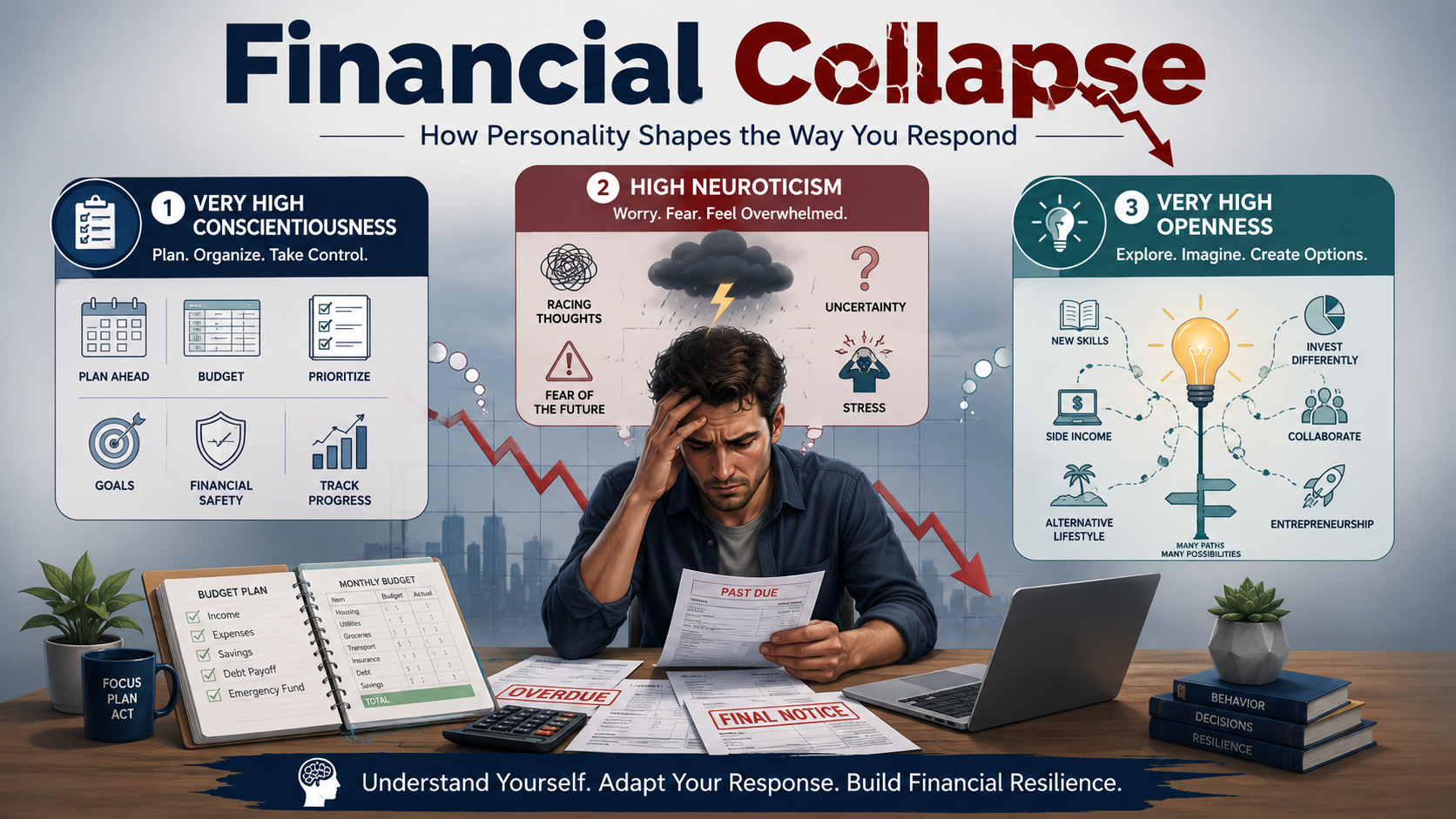
Average Neuroticism can help you recognize a real threat and respond without you getting into panic mode. The loss of income security can make every uncertain detail feel urgent.
High Conscientiousness helps you organize tasks and follow through plans to resolve the crises. Average Neuroticism, again prevents you from falling into deep despair. You might fill each day with applications, checks, and revisions while leaving little time to assess results.
Average Openness lets you consider other ways to use your skills; concern about stability may make unfamiliar options look too risky or make every option seem equally urgent. You feel pressure to accept any option. However, taking time to compare choices can help you identify which ones fit your needs.
Low Extraversion may help you think privately before discussing a difficult change. At the same time Average Neuroticism may increase worry if you keep every concern to yourself. You may delay telling people who could share useful information. However, one focused conversation can give you a clearer view of your options.
Average Agreeableness allows you to ask for help in a limited manner. You may worry about burdening others and decline support too quickly. The practical tasks then feel heavier because you carry them alone. However, a specific request can make support easier to give and easier to accept.
Neuroticism and Conscientiousness can turn concern into a short, ordered plan. Write down the facts you know, the immediate tasks, and the questions that need answers. Choose what to do today before planning later steps. Review your progress at a set time instead of checking constantly. A clear next action can reduce uncertainty without pretending it has disappeared.
Neuroticism and Openness can help you explore options at a manageable pace. Identify a few roles or paths that fit your skills, then learn what each requires. You can consider a new direction without committing to it immediately. Exploring is part of deciding.
Neuroticism and Extraversion can support a private, direct request for help. Tell one trusted person what happened and ask for a specific kind of support or information. You can share what is useful while keeping other details private.
Neuroticism and Agreeableness can help you accept practical support without giving up your judgment. Let others know what would help, then decide which suggestions fit. Needing support during a sudden change is reasonable.
Deep grief and loss create existential questions, emotional paralysis or spiritual searching.
News of a close person’s death or terminal illness changes what you expected the day to be. High Neuroticism may make the fear or grief hard to set aside. You feel numb and then suddenly cry. These changes in feeling can occur even while you are trying to understand the basic facts.
Right after, Low Openness may draw you toward familiar routines and clear information. Paired with High Neuroticism, an uncertain medical course or an unexpected loss can make it hard to know what to do next. You may ask the same practical questions more than once. Clear answers can help, though some questions may remain unanswered for now.
As other people respond, Low Agreeableness may make you protective of your space and direct about what you can bear. High Neuroticism can make unwanted advice or repeated questions feel especially difficult. You quietly feel a need for others to respect your limits. You may care about their support while still wanting them to stop talking for a while.
When practical duties arise, Average Conscientiousness may help you handle one necessary task at a time. High Neuroticism may still interrupt your focus with fear or grief. You feel a hole in your routine. Trying to keep every part of the day normal can become tiring, so your usual pace may need to change.
Later, Very High Extraversion may make you want to talk, remember the person, or stay close to others. High Neuroticism can also make those conversations painful without warning. You may seek company and then need quiet soon afterward. Both needs can change from day to day as you respond to the news.
Neuroticism and Openness can help you work with the facts available today. Ask for a clear explanation when you need one, and allow unanswered questions to remain open. Familiar routines may offer support, but you can adjust them when grief or caregiving changes your day. You only need to handle the next part of the situation now.
Neuroticism and Agreeableness can help you state your needs directly. Tell others whether you want company, practical help, or time alone. You can accept care while setting limits on advice and questions. Your needs may change, and you can say so.
Neuroticism and Conscientiousness can help you choose one necessary task and leave less urgent work for later. A short list or help from another person may reduce the load. A slower pace is understandable here.
Neuroticism and Extraversion can help you share memories or fears with someone you trust. You may talk for a while and then ask for quiet. Both can be ways of caring for yourself.
Sudden money loss threatens survival needs, personal freedom and long-term security.
Very High Conscientiousness helps you gather facts and organize urgent tasks. The sudden loss may push you to make strict rules before you understand the full situation. You may spend hours checking small details while larger questions wait. However, careful work helps most when you decide which facts matter first.
High Neuroticism alerts you to risks that deserve attention. Paired with Very High Conscientiousness, it may lead you to review the same figures without reaching a decision. Each check can briefly ease worry, then raise another question. However, repeated checking cannot provide certainty about every future cost.
Very High Openness helps you imagine ways to adapt. It can also produce too many possible outcomes when you are already under strain. You feel pressure to fix everything fast. However, listing possibilities is more useful when you choose which one needs attention now and which can wait.
Average Agreeableness allows you to discuss the problem and accept support. On the other side, concern about how others will react may make you delay a necessary conversation. You may prepare every detail before saying that you need help.
Very High Extraversion can help you speak up and find people with useful information. Urgency may lead you to make promises before you have checked what is possible. You may sound confident while still feeling unsure. However, taking time to verify a commitment protects you and the people relying on you.
Conscientiousness and Neuroticism can help you respond to concern with a clear order of tasks. Record the facts you have, mark the questions that remain, and choose the most urgent next contact or document. Set a time to review new information instead of checking continuously. You can take the situation seriously without solving every uncertainty today.
Conscientiousness and Openness can help you examine options one at a time. Write down what each option requires and which facts you need before deciding. Your ability to see possibilities is useful when it leads to a manageable next step. A plan can change as you learn more.
Conscientiousness and Agreeableness can help you make a specific request for support or information. Explain the immediate issue and what kind of help would be useful. You can be clear about your needs without explaining every past decision.
Conscientiousness and Extraversion can help you communicate early while checking commitments carefully. Share what you know, state what remains uncertain, and follow up when you have facts. Clear communication does not require an instant answer.
Six readings, generated from your own thirty facet scores.
Each statement explores a part of your personality. Answer to the extent you agree.
“The stress section described a pattern I had never been able to put into words. My manager and I now use it as shared language.”
“I have taken three personality tests. This is the first report I actually re-read a month later.”
“Fifteen minutes, no upsell, and the career section was specific enough to be uncomfortable. That is the point.”

Uncertainty about the future can feel stressful even when nothing bad has happened yet. A person may be waiting for exam results, a job offer, a medical report, a busi...
Read the piece →Psychology you can apply, in under four minutes. No promotions, unsubscribe whenever.
Four clickable sections from a real report.
Every facet placed on its own scale, with what a high and low score means for you.
Open sample →Motivation, regulation and attention read together as one picture.
Open sample →Roles, teams and environments where this profile tends to do its best work.
Open sample →Your triggers, your tells, and the recovery pattern that fits your traits.
Open sample →