
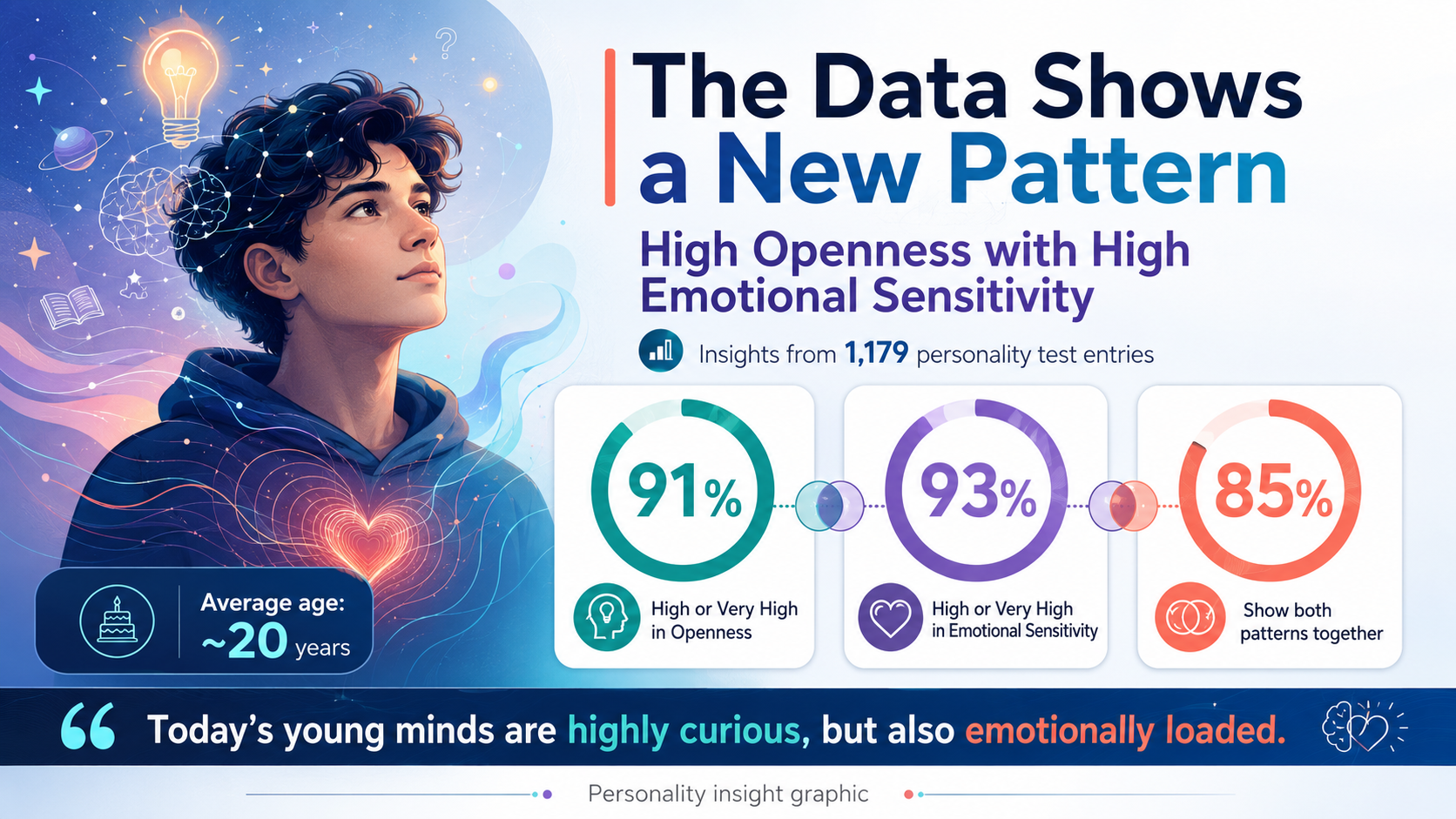
Personality data from Truemelytics shows an interesting pattern among young users. A large number of users are scoring high in Openness and also high in Neuroticism, which can be understood as emotional sensitivity.
This is not a small trend. In the available test data, more than 91% users are High or Very High in Openness. At the same time, around 93% users are High or Very High in Neuroticism. Even more interesting, around 85% users show both patterns together.
This means many users are not just curious, creative, and open-minded. They are also emotionally intense, sensitive to stress, and deeply affected by uncertainty, criticism, pressure, or confusion.
This combination tells us something important about today’s young mind.
High Openness means a person is ready to explore ideas, question old systems, think deeply, imagine new futures, and look for meaning. Such people do not want simple labels. They want to understand themselves better. They ask: Who am I? What should I become? Why do I react this way?
But when high Openness comes with high emotional sensitivity, the same thinking power can become heavy. A curious mind may also become an overthinking mind. A person who wants meaning may also feel lost when life is unclear. A person who imagines many possibilities may also feel anxious about choosing the wrong path.
This pattern is especially important for students, young professionals, and career seekers. Many of them are not lazy or careless. They may simply be mentally overloaded. They have dreams, ideas, and ambition, but they also carry fear, doubt, pressure, comparison, and emotional stress.
For example, a young person may want to explore many career options, but this freedom can create confusion. Another person may be highly creative, but criticism may hurt deeply. Someone may want personal growth, but may also feel anxious about failure.
This is why personality assessment should not only tell people their trait scores. It should explain how traits work together. A high Openness score alone does not show the full picture. A high Neuroticism score alone also does not show the full picture. But when both are seen together, we get a deeper understanding.
The data suggests that many young users today are living with a powerful inner contrast: they are open to growth, but emotionally sensitive to pressure. They want clarity, but they also feel burdened by too many choices. They want success, but fear failure. They want self-expression, but may worry about judgment.
This is where Truemelytics becomes useful. It does not label people as good, bad, weak, or strong. It decodes patterns. It helps users understand why they think, feel, react, and decide in certain ways.
The key message is clear: emotional sensitivity is not weakness. When understood properly, it can become self-awareness. High Openness is not confusion. When guided properly, it can become creativity, learning, and growth.
Today’s young minds need more than motivation. They need self-understanding. They need tools that explain their inner patterns in simple language. They need guidance that connects personality, stress, career choices, and decision-making.
The Truemelytics data shows a new reality: the modern young mind is highly curious, but also emotionally loaded. It is ready to grow, but needs clarity. It wants freedom, but also needs direction.
Understanding this pattern can help parents, teachers, institutions, counsellors, and young people themselves. When we understand the mind better, we can guide it better.
That is the future of personality assessment. Not labels. Not fixed boxes. But deeper clarity.